以下文章来源于小麻哥的日常 ,作者两只小绵羊
摘要译文(供参考)
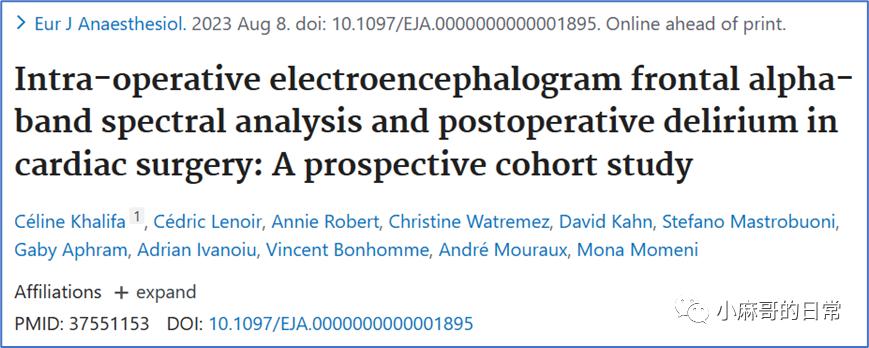
心脏手术中术中脑电图额叶α波分析与术后谵妄的前瞻性队列研究
原文摘要
Intra-operative electroencephalogram frontal alpha-band spectral analysis and postoperative delirium in cardiac surgery: A prospective cohort study
Background:Postoperative delirium (POD) remains a frequent complication after cardiac surgery, with pre-operative cognitive status being one of the main predisposing factors. However, performing complete pre-operative neuropsychological testing is challenging. The magnitude of frontal electroencephalographic (EEG) α oscillations during general anaesthesia has been related to pre-operative cognition and could constitute a functional marker for brain vulnerability.
Objective:We hypothesised that features of intra-operative α-band activity could predict the occurrence of POD.
Design:Single-centre prospective observational study.
Setting:University hospital, from 15 May 2019 to 15 December 2021.
Patients:Adult patients undergoing elective cardiac surgery.
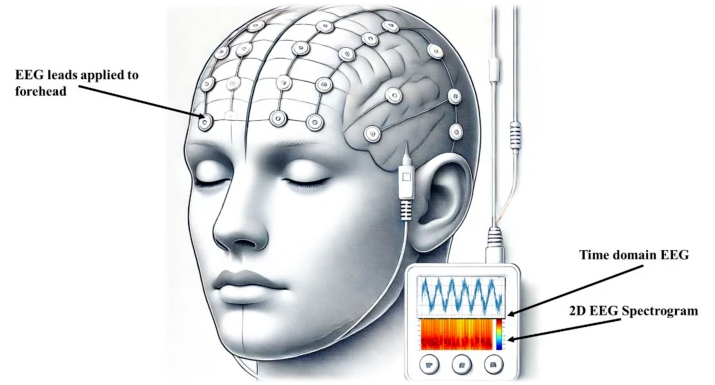
Main outcome measures:Pre-operative cognitive status was assessed by neuropsychological tests and scored as a global z score. A 5-min EEG recording was obtained 30 min after induction of anaesthesia. Anaesthesia was maintained with sevoflurane. Power and peak frequency in the α-band were extracted from the frequency spectra. POD was assessed using the Confusion Assessment Method for Intensive Care Unit, the Confusion Assessment Method and a chart review.
Results:Sixty-five (29.5%) of 220 patients developed POD. Delirious patients were significantly older with median [IQR] ages of 74 [64 to 79] years vs. 67 [59 to 74] years; P < 0.001) and had lower pre-operative cognitive z scores (-0.52 ± 1.14 vs. 0.21 ± 0.84; P < 0.001). Mean α power (-14.03 ± 4.61 dB vs. -11.59 ± 3.37 dB; P < 0.001) and maximum α power (-11.36 ± 5.28 dB vs. -8.85 ± 3.90 dB; P < 0.001) were significantly lower in delirious patients. Intra-operative mean α power was significantly associated with the probability of developing POD (adjusted odds ratio, 0.88; 95% confidence interval (CI), 0.81 to 0.96; P = 0.007), independently of age and only whenever cognitive status was not considered.
Conclusion:A lower intra-operative frontal α-band power is associated with a higher incidence of POD after cardiac surgery. Intra-operative measures of α power could constitute a means of identifying patients at risk of this complication.
免责声明:本平台所刊载原创或转载内容不代表迈可医疗的观点或立场。文中所涉及药物使用、疾病诊疗等内容仅供医学专业人士参考。
迈可医疗编辑部
采集信号,感知生命,守护健康